The Jupe and the Wob Dwiyet
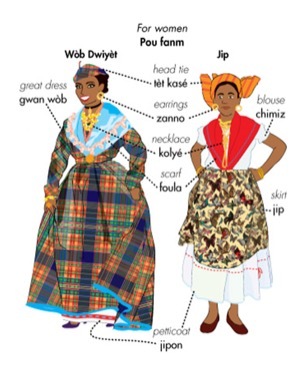
The first creole dress was said to be worn by freed women on Sundays and feast days and was referred to as the “Jupe”. This outfit was worn to celebrate our freedom and independence. It consists of a brightly coloured floor length skirt over a white cotton chemise. The neck, sleeves and hem were trimmed with lace and a white handkerchief was wrapped around the head or sometimes shaped into a bonnet. A “Foulard”, a white or coloured cotton triangle, was laid around the neck, over the shoulders. The dresses resembled those of French provincial women.
As the dress evolved, the “madras” began to replace the white handkerchief and creole women began to use a pliable material, known as “imite”, for their foulards and even for their jupes. About the same time, petticoats and ribbons, which were threaded through the lace of sleeves and neck of chemise, became fashionable.
Today, we have the complete jupe assemble which is rather very prevalent. It consists of a mouchoir (handkerchief), foulard, jupe, chemise,and ‘jupon a dantelle’, which is basically a petticoat with lace. This outfit would then be completed with gold jewelry on the arms, ears, neck and mouchoir, and a black flat shoe or block heel. Long sleeved dresses with duller materials began to take the place of the jupe. However, the Creole bird of Paradise, “ dou-dou matador”, which is a nickname for the national bird, brought about bright colors to the local fashion again.
The Jupe was very popular since it was less elegant and simple. It consisted of the same petticoat, at a shorter length, and colourful headpiece. This was worn with a short sleeved white blouse and tucked into the petticoat with cloth hanging over one shoulder. This wear is more accepted and appreciated by the youth.Some ladies preferred to wear the “ti robe” or jupe over the “grand robe”.